


Beaker filling variability
The beaker should always be filled with the same amount of water.
Before proceeding the analize the water sample, a purge must be performed. In the purge the beaker and the water in tube are completely emptied, to be sure that the water that is going to be analyzed comes from the aquarium and from this exact moment. In the first purge phase, the beaker should be completely empty. And then be filled up to almost the 60ml mark. When the analysis is finished, a new purge takes place, in which the beaker is completely emptied (of the mixture of water and reagent), to fill it with new aquarium water.
-
- If the beaker is not completely emptied, and it was previously filled to the 60ml mark (or close to it), the water out pump may not be working properly.
- If the beaker does not empty completely after a test, make sure that the rigid tube is in contact with the bottom of the beaker. If it was well placed, the problem may be the water out pump.
-
- If the beaker empties completely on both initial and final purge, but fills above the 60ml mark, clearly below it, or fills irregularly each analysis. There may be a problem with the water in pump.
Leaks
- Open the head (follow the instructions below).
- Check the inner tube for any cuts (it is normal to find black rubber particles and some dirt in G1 pumps).
- Check the pump shaft for rust.
- If you see a gray ring-shaped piece, and it is broken, remove it.
- If you do not see anything strange, reassemble it carefully and tighten the parts well.
Very important: G1 pumps (KH, Ca, Trace, Water In and Water Out) are friction pumps, (Kamoer & Cinyar) the rollers of the heads should never be lubricated, nor any other part of the pump head, since they would lose their capacity to transmit the movement.
Insufficient maintenance
- Check the condition of the inner tube (see instructions below).
- It is normal to find black rubber particles and some dirt, but if you see any damage, wear and tear or if you see a lot of variability between calibrations, replace the tube. The water out pump cannot be calibrated, but you can purge it for a minute and see how many mililiters it draws. If the figure is too low or inconsistent, replace the inner tube.
- If it has been more than a year since the last change, replace the inner tube of the pump heads.
Very important: G1 pumps (KH, Ca, Trace, Water In and Water Out) are friction pumps, (Kamoer & Cinyar) the rollers of the heads should never be lubricated, nor any other part of the pump head, since they would lose their capacity to transmit the movement.
Incorrectly attached head
- Loosen the head and check the parts.
- Assemble the head carefully tightening all parts securely.
Inner rollers do not rotate
- If the flow rates are insufficient, it is possible that the rollers are not turning. Water In and Water Out pumps are friction pumps, the head rollers should never be lubricated, nor any other part of the head, as they will lose their ability to transmit movement. If they have been lubricated, you can try to clean and dry them thoroughly. As long as they are somewhat lubricated they will not work properly. If you are unable to clean them properly, you can purchase a new pump head as a spare part to replace it.
Instructions for disassembling the head
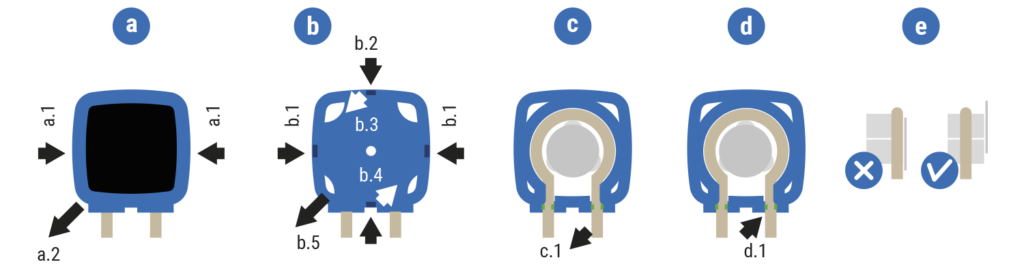
- a) Press (1) and pull the pump head (2).
- b) Press (1) and (2). Then pull (3) and (4) to release the back cover
- c) Check the inner tube, or release it if is damaged (1)
- d) Place the new tube in the head around the rollers (if needed), starting from one green holder (1). Release the rollers in needed, be careful to not damage the inner tube.
- e) Press the tube to position the tube in the middle of the rollers.
- d) Place the back cover and place the head in the pump frame. Be sure you heard de clicks, to ensure that is propertly mounted.